


The Enterprise AI Rush Has a Judgment Problem

Walk into enough executive meetings today and you'll eventually hear the same sentence:
“We need an AI strategy.”
The board is asking about it.
Competitors are announcing investments.
Employees are experimenting.
Investors want answers.
And nobody wants to be the CEO explaining three years from now why their company missed the biggest technology shift since the internet.
That urgency is understandable.
It's also creating one of the biggest problems in enterprise AI:
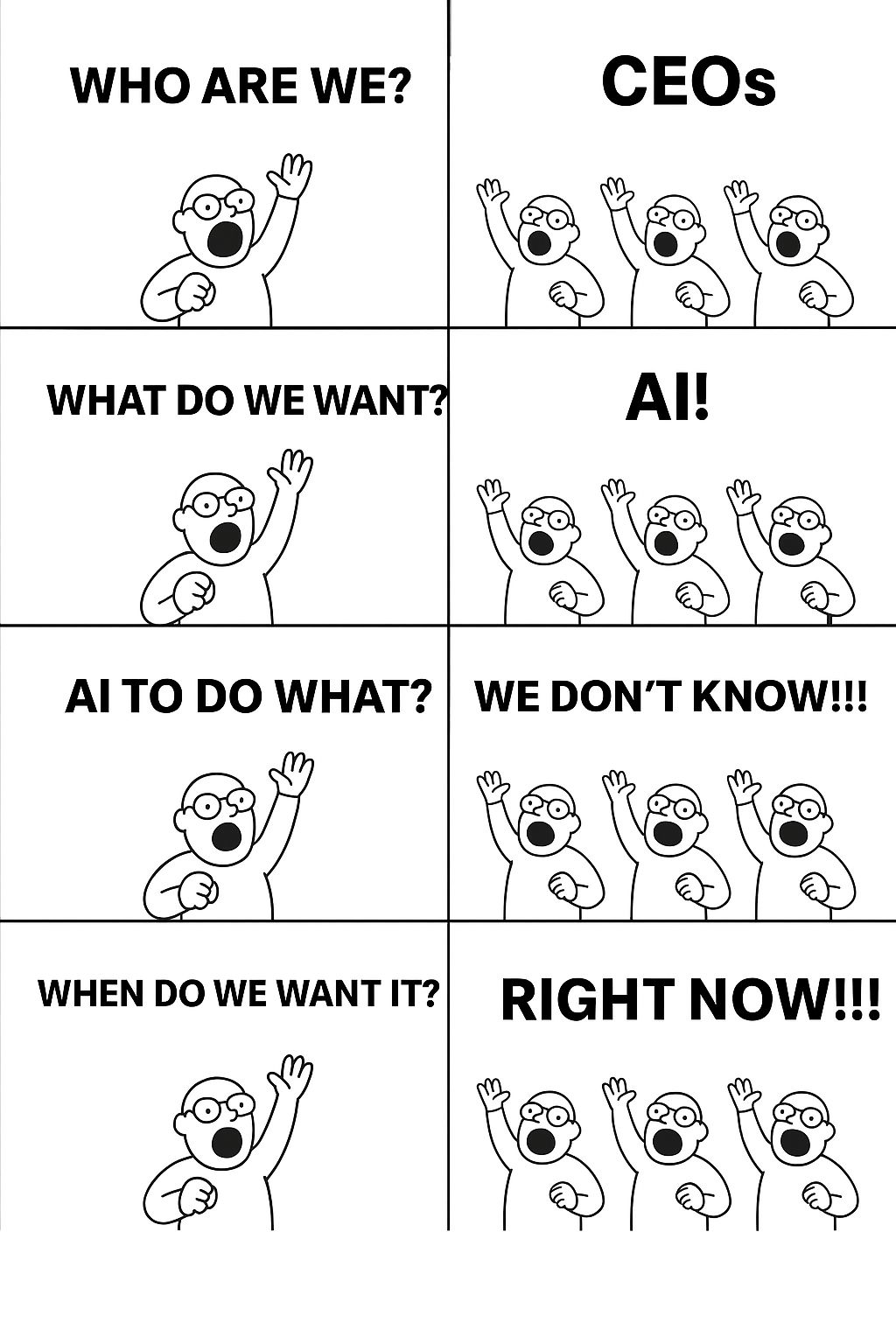
Companies are deciding that they need AI before deciding what problem is worth solving.
The result is an inversion of good strategy.
Instead of:
Business problem → value → solution → technology
we increasingly get:
AI → use case → justification → projected value
That difference is where a lot of money disappears.
Enterprise AI spending is rising faster than enterprise AI ROI
The numbers show the tension.
PwC surveyed 4,454 CEOs across 95 countries and territories in its 2026 Global CEO Survey. 56% said AI had produced no significant financial benefit, while only 12% reported both revenue and cost benefits. PwC
Yet investment keeps climbing.
Deloitte found that 85% of organizations increased AI spending during the previous year and 91% planned to increase it again. Most respondents said satisfactory ROI on a typical AI initiative takes two to four years. Deloitte
That doesn't mean companies should stop investing.
AI is likely to become foundational to how businesses operate.
But it does raise an important question:
Why are enterprises accelerating investment before many can clearly demonstrate the economics?
Part of the answer is technology.
Part is experimentation.
And part is simple human behavior.
FOMO is becoming part of enterprise AI strategy
Imagine you're a CEO.
Your board asks what you're doing about AI.
Your largest competitor announces a major partnership.
Every earnings call includes AI.
Your leadership team wants a roadmap.
You can say:
“We've studied the business and don't currently believe a massive AI program is the highest-return use of capital.”
Or you can launch an AI transformation.
One answer is considerably easier to defend.
This creates a dangerous incentive.
The executive may not know where AI will create material value.
The consultant may not know yet either.
But everyone has an incentive to find something.
I call this the invest first, find a use case later mentality.
Once that happens, AI stops being a tool for executing strategy.
AI becomes the strategy.
Technical success is not business success
This distinction gets lost constantly.
An engineering team can build a system that works exactly as intended.
The model performs.
The integrations work.
Users can access it.
The project launches.
And it can still be a terrible investment.
If a company spends $10 million to eliminate $200,000 of annual cost, the implementation may be technically impressive while being economically absurd.
AI doesn't suspend the laws of business.
The question isn't merely:
Can we build this?
It is:
Is this problem valuable enough to justify building it?
That requires business judgment before engineering begins.
And as AI makes software dramatically easier to create, that judgment becomes more—not less—important.
Start with the constraint, not the AI use case
A better enterprise AI strategy starts by temporarily removing AI from the conversation.
Ask:
What are the most expensive constraints in this business?
Where are we losing revenue?
Where is margin leaking?
Where is valuable capacity trapped?
Which decisions are consistently slow or wrong?
Where are customers leaving?
Where is experienced human judgment buried underneath repetitive work?
Quantify those problems first.
Maybe one problem is worth $40 million annually.
Another is worth $8 million.
Another is worth $300,000.
Now ask whether AI materially changes the economics of solving them.
Sometimes it will.
Sometimes traditional software will be better.
Sometimes the workflow simply needs to be redesigned.
Sometimes the problem is incentives, organizational structure or an unnecessary approval process.
AI should have to earn its place in the solution.
That isn't skepticism about AI.
It's capital discipline.
The strongest AI companies aren't simply deploying more AI
McKinsey's latest research captures the gap well.
While 80% of respondents report individual productivity improvements from AI, only 37% report EBIT impact. Just about 6% qualify as AI high performers, including organizations attributing at least 5% of EBIT to AI and describing its impact as significant. McKinsey & Company
BCG found a similar execution problem. More than half of CEOs cited linking AI initiatives to P&L as a challenge, while only 14% had clearly defined P&L impact across all AI initiatives. BCG Global
That is the part of the enterprise AI conversation that interests me most.
The technology is improving extraordinarily quickly.
The bottleneck is increasingly becoming the organization's ability to decide where to point it.
Enterprise AI needs judgment and engineering
This is also why I don't believe the future belongs exclusively to either consultants or engineers.
Expecting one Forward-Deployed Engineer to simultaneously be a world-class strategist, product leader, engineer, industry expert, executive communicator and organizational politician is unrealistic.
Those people exist.
They're just exceptionally rare.
A stronger model pairs different forms of expertise.
Industry leaders bring tacit knowledge and understand the economics, edge cases and operational realities of the business.
Forward-deployed strategists and engineers translate those priorities into working systems.
AI gives both groups enormous leverage across research, analysis, prototyping, coding and iteration.
The order matters.
Judgment determines where to aim. Engineering determines how to build. AI increases the speed of both.
Without the first piece, companies can simply become better at moving quickly in the wrong direction.
Five questions before funding an AI initiative
Before committing serious capital to enterprise AI implementation, leadership should be able to answer:
- What business problem are we solving?
- What is that problem financially worth?
- Why is AI better than the available alternatives?
- What measurable business outcome defines success?
- What evidence would cause us to stop the project?
That fifth question matters.
Organizations usually have processes for approving investment.
They need equally strong processes for killing bad investments before sunk costs, internal politics and executive ego make stopping them impossible.
The objective isn't to protect the AI initiative.
The objective is to protect the business.
The AI winners won't be the companies that simply move fastest
I believe AI will transform virtually every major enterprise.
But that doesn't mean AI belongs everywhere today.
Every department doesn't need an agent.
Every workflow doesn't need automation.
And every company doesn't need to spend millions because competitors are doing it.
The companies that win will still move quickly.
They'll just make one critical decision before accelerating:
Where is speed actually worth something?
They'll identify expensive problems.
Put experienced judgment close to them.
Build where technology materially changes the economics.
Measure actual outcomes.
And kill initiatives when the evidence stops supporting them.
Because as AI makes it cheaper to build almost anything, one capability becomes increasingly valuable:
Knowing what is worth building in the first place.
Don't trade dollars for pennies.